
Zermatt
A car-free village beneath the Matterhorn, with skiing up to the glacier and over the border into Italy
At the head of the Mattertal in the Valais, Zermatt sits at around 1,610 metres, with the Matterhorn, 4,478 metres, standing over its rooftops. In winter the village is above all a point of departure. In the morning ski boots clatter along the Bahnhofstrasse towards the cog railway, the underground funicular and the gondola to Furi, and half an hour later their owners are well above 3,000 metres. There are no petrol cars here: visitors leave theirs in Täsch and arrive by shuttle train, and the streets belong to small electric taxis.
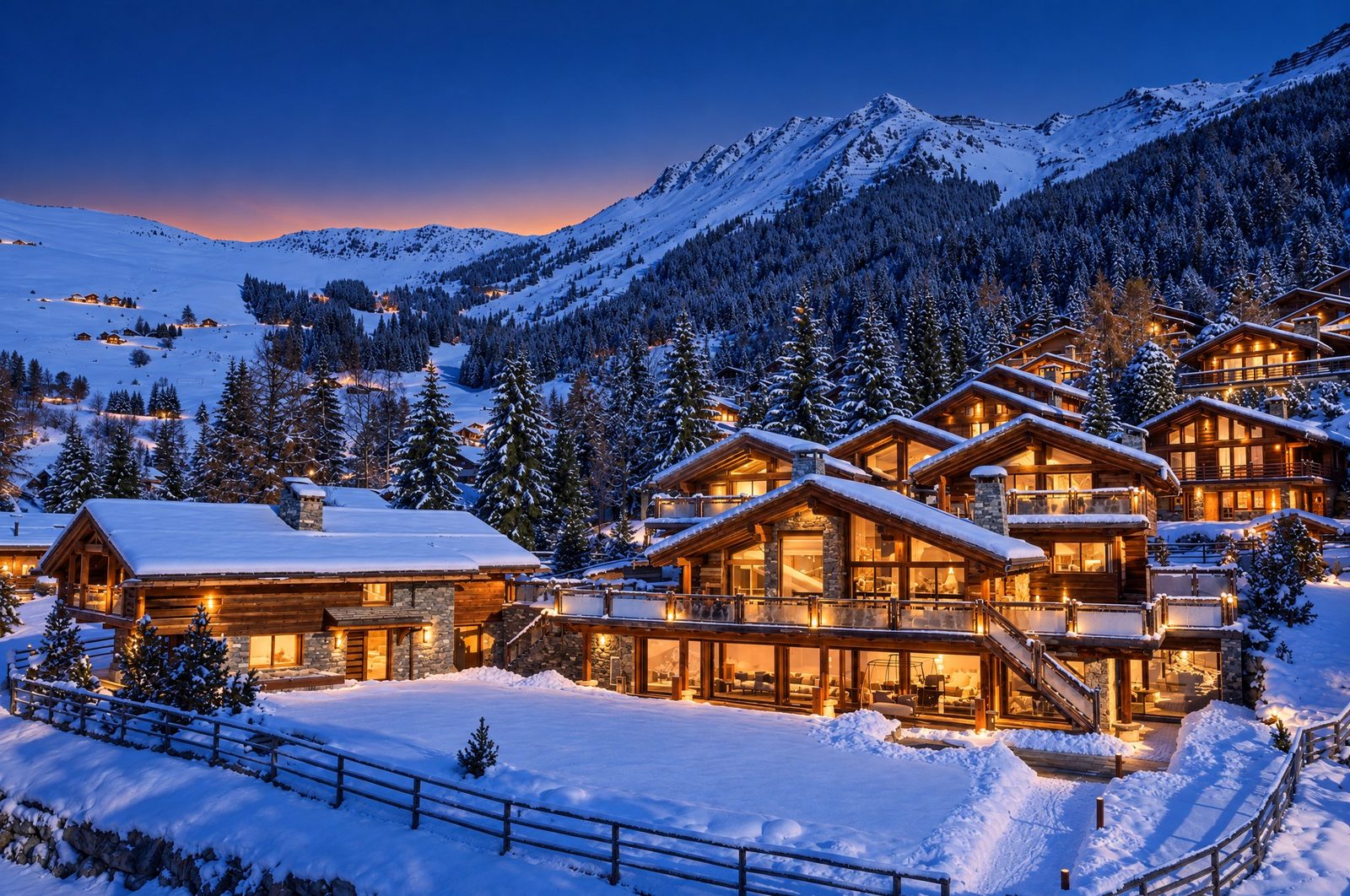
The ski area, known as the Matterhorn Ski Paradise, crosses the border into Breuil-Cervinia and Valtournenche in Italy's Aosta Valley. Together that makes around 360 kilometres of pistes, roughly 200 of them on the Swiss side, topping out at 3,883 metres on the Klein Matterhorn, where the glacier is skied all year. On a day off the slopes there is tobogganing below the Gornergrat, cross-country skiing on the valley floor at Täsch and snowshoeing among the four-thousanders. Chalets are spread through the village and across the slopes above it, many with the Matterhorn framed in the window.
Our Zermatt residences


The Zermatt experience


The village in winter
Snow suits Zermatt. The Bahnhofstrasse runs from the station to the church of St Maurice, and behind it, in the Hinterdorf, the old timber barns and granaries stand on their flat stone staddles beneath a thick white cap. Under the church square, the Matterhorn Museum tells the story of the first ascent in 1865. Late in the afternoon the skiers come home, some on foot down the last stretch of piste from Furi, others by funicular from Sunnegga.
Each January the Obere Matten, in the middle of the village, hosts the Horu Trophy, an open-air curling tournament with some 76 teams on 19 sheets. In April, Zermatt Unplugged fills the village with concerts in a large tent and on smaller stages around it. For quieter days there are waymarked winter walking trails, among them the hour-long route from Rotenboden down to Riffelberg, past the frozen Riffelsee.
Three mountains and a frontier
The Swiss side divides into three areas. To the east, the underground funicular climbs to Sunnegga, and a gondola and cable car continue to Blauherd and the Rothorn at 3,103 metres: broad, sunny pistes and the run down to Findeln. In the centre the Gornergrat railway rises to 3,089 metres, serving long, unhurried runs via Riffelberg and Riffelalp, while above it, around the Rote Nase and the Stockhorn, lies the steeper ground that draws freeriders. To the west, the lifts climb from Furi to Schwarzsee, Trockener Steg and the Klein Matterhorn.
From the Klein Matterhorn and the Testa Grigia, 3,480 metres and right on the border, the Italian side opens up towards Breuil-Cervinia and on to Valtournenche. You will need an international lift pass, and it pays to keep an eye on the clock: in high winds the border lifts close. The way home is a descent of more than 2,000 vertical metres, across the Theodul glacier and past Schwarzsee to Furi. The season runs from late November into the second half of April, and on the glacier the skiing simply carries on.
Long lunches and late afternoons
Lunch here is taken on the mountain. In Findeln, at just over 2,000 metres, Chez Vrony and the Findlerhof have terraces that face the Matterhorn head on; lower down, in the hamlet of Zum See on the way to Furi, you eat among old timber houses. Ski across to Italy and lunch becomes pasta and a glass of Aosta Valley wine in Cervinia, before the lifts carry you back up to the frontier.
Après-ski starts at Hennu Stall, beside the piste between Furi and the village, where music and a crowded terrace come before the final stretch home. In the village, the Papperla Pub and the bar at Cervo, near the Sunnegga valley station, are long-standing addresses. Evenings turn to raclette or fondue with a glass of Fendant, Cornalin or Petite Arvine from the canton itself: the Valais is Switzerland's largest wine-growing region.
A week in Zermatt
Cross the Testa Grigia on an international pass, lunch in Breuil-Cervinia and ski back into Switzerland.
Take the cog railway to Rotenboden and sledge roughly 1.6 kilometres down to Riffelberg.
A waymarked route of about 2.5 kilometres from the Gornergrat to Rotenboden, easily done without a guide.
A flat loop of about ten kilometres on the valley floor towards Randa, twelve minutes from Zermatt by train.
A mountain guide and an Air Zermatt helicopter to one of the permitted landing sites, such as the Alphubeljoch.
Music and a packed terrace beside the piste from Furi, just before the last run into the village.
Did you know
Every other year in April, the Swiss Army's Patrouille des Glaciers ski-touring race runs from Zermatt via Arolla to Verbier: 57.5 kilometres with more than 4,300 metres of climbing.
Since July 2023 the Matterhorn Alpine Crossing has linked the Klein Matterhorn with the Testa Grigia, so even non-skiers can reach Cervinia by cable car.
The glacier below the Klein Matterhorn is skied all year round, even in high summer.
The toboggan run from Rotenboden to Riffelberg starts at more than 2,800 metres and is considered the highest in Switzerland.