
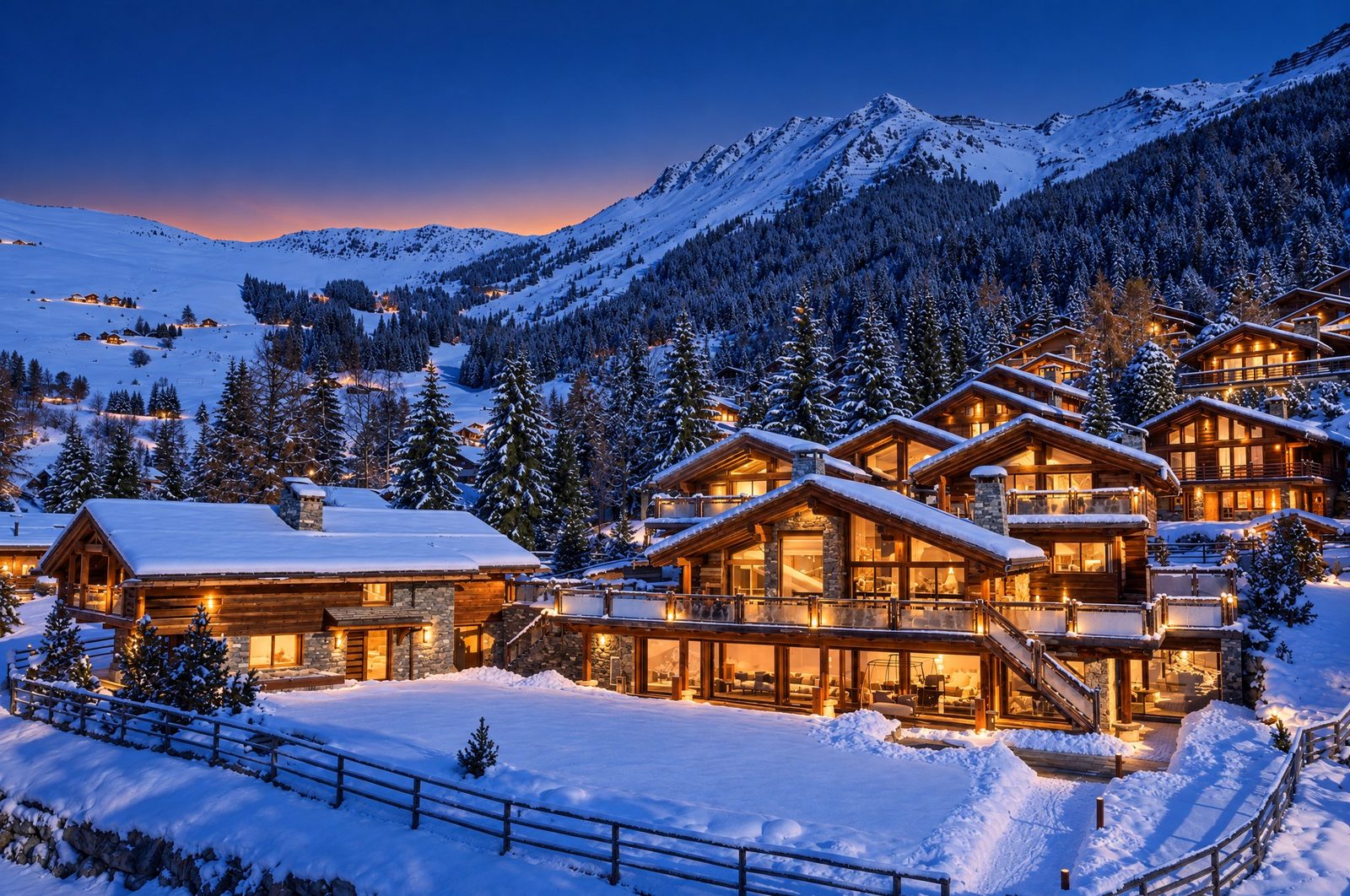
St Anton
The village that gave modern skiing its method, at the foot of the Valluga
St Anton am Arlberg sits at 1,304 metres in the far west of the Tyrol, on the eastern side of the Arlberg Pass. Hannes Schneider opened a ski school here in 1921, and the Arlberg technique he taught went on to be adopted the world over. The village wears that history lightly. The lifts leave from virtually the centre, the station is a short walk from the pedestrian street, and a day on the mountain begins without a car. From early December to mid-April, St Anton is the largest village in Ski Arlberg, Austria's largest linked ski area.
The skiing has a reputation for steepness, and for more than 200 kilometres of off-piste descents beneath the Valluga, the high point at 2,811 metres. Across the valley, the Rendl is a mountain of its own with its own base station, and a quieter place to ski. Après-ski here traditionally starts on the last run of the day, in the huts above the village, before the evening moves down into the centre. The chalets are spread across the village itself, Nasserein and St Jakob.
Our St Anton residences


The St Anton experience


The village in winter
In winter, life in St Anton runs along the pedestrian street between the church and the lift stations. Hotels, ski shops and terraces sit shoulder to shoulder, and dinner is always within walking distance. A little to the east is Nasserein, with its own gondola to the Gampen; from there a four-kilometre toboggan run drops to the valley, open on Thursday evenings as well as by day. An ice rink, curling and horse-drawn sleigh rides round out the time off the slopes.
Higher up the pass, at about 1,800 metres, lies St Christoph. Heinrich Findelkind built a refuge for travellers crossing the Arlberg here in 1386, and the Ski-Club Arlberg was founded on the same spot in 1901. In winter the hamlet sits right among the Galzig pistes. Cross-country skiers have a trail at 1,800 metres, and down in the valley a ten-kilometre trail runs into the wooded quiet of the Verwall.
From the Valluga to the Rendl
St Anton skis on both sides of the valley. To the north, the lifts climb by way of the Gampen, the Kapall and the Galzig to the Valluga; to the south lies the Rendl. Ski Arlberg as a whole has around 300 kilometres of pistes and 85 lifts, shared between St Anton, St Christoph, Stuben, Lech, Zürs, Warth and Schröcken. Since the 2016/17 season the Flexenbahn has joined the Tyrolean and Vorarlberg sides, so you can ski all the way to Lech, and the Run of Fame follows that link for around 85 kilometres.
St Anton made its name off the piste. The area has more than 200 kilometres of deep-snow descents and ski routes, none of them groomed. The little cable car to the summit of the Valluga takes skiers only in the company of a certified mountain guide, and from the top the descents leave every piste map behind. Those who prefer to stay on piste can ski some nine kilometres from the Valluga to the valley, the longest run in the area.
Lunch, dinner and the run home
On the Galzig, at 2,085 metres, the Verwallstube serves lunch by day and, on certain evenings, dinner by candlelight. In St Christoph, right on the piste, the Hospiz Alm is a ski hut at lunchtime and something more refined after dark; its Gothic wine cellar is known for large-format bottles, Bordeaux above all. In the huts the cooking stays Tyrolean: Kaspressknödel in broth, Tiroler Gröstl and Kaiserschmarrn.
After the last lift, après-ski begins on the way down. The MooserWirt, the Krazy Kanguruh, which has stood here since 1965, and the Heustadl with its live music all sit on the slope above St Anton, and the final stretch into the village is skied afterwards. For a quieter evening, carry straight on into the village, where the night starts more slowly, with an aperitif and a table booked in advance.
A week in St Anton
Around 85 kilometres across Ski Arlberg, over the Flexenbahn to Zürs and Lech and back again.
With a certified mountain guide to the top of the Valluga and into the deep snow.
The viewpoint at 2,811 metres, open to walkers without skis, looking as far as Graubünden.
Four kilometres down to the valley, by day and on Thursday evenings after dark.
Ten kilometres of trail from the edge of the village into the quiet Verwall valley.
By candlelight on the Galzig, at 2,085 metres.
Did you know
Hannes Schneider opened his ski school in St Anton in 1921. His Arlberg technique, built on the stem turn, was later taught all over the world.
The first Arlberg-Kandahar, devised by Schneider and the Briton Arnold Lunn, was raced here in 1928. In 2001 St Anton hosted the Alpine World Ski Championships.
The season closes in April with Der Weisse Rausch: 555 racers set off together from the Valluga ridge and race down to the valley over ungroomed snow.
According to Ski Arlberg, the area receives an average of around nine metres of snow each winter.